


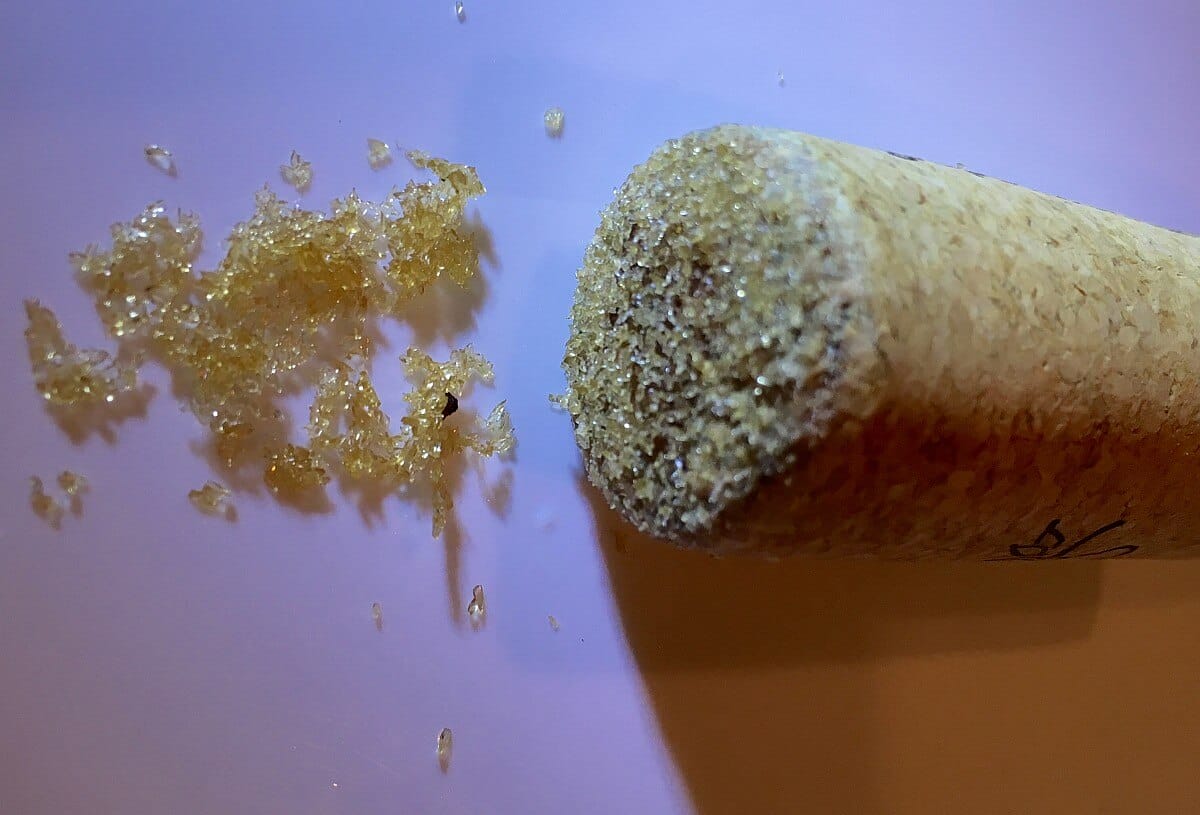
Have you ever noticed “wine diamonds” on the bottom of a wine cork? Or have you wondered about the stuff that looks like beach sand in your wine glass? Such sediment is certainly unattractive and bothersome, but is completely harmless. The chemical composition of the sediment is potassium bitartrate (KbTA), an inert, relatively insoluble salt which is a natural by-product of winemaking formed from tartaric acid, the most abundant acid found in grapes and almost all other fruits.
There is no need to stress over the chemistry involved in creating KbTA, but it is important to understand why some wines have this sediment, while most do not. During the winemaking process, a portion of the natural tartaric acid that helps keep a wine fresh and lively gets converted into the mono-potassium salt KbTA. This salt is very insoluble, and over time molecules of it will conglomerate together forming sediment. The longer a wine sits (like reds aging in a barrel or whites in a tank), the more KbTA sediment will form and fall to the bottom of the container.
Temperature also plays a role in forming KbTA sediment, especially for white wines. Since KbTA is less soluble in wine at lower temperatures, most of it will precipitate out on the bottom of the container when chilled. This is actually the basis of the cold stabilization process used by most winemakers. Traditionally, cold stabilization is accomplished by keeping wine in a chilled tank for 5-10 days at 24-26 degF (degrees Fahrenheit). This cold stabilization procedure is usually sufficient to reduce KbTA levels so that no sediment forms when a bottle of the finished is later refrigerated at 35-40 degF before consumption.
Red wines, once bottled, tend to form less KbTA sediment than white wines. This is because red wines are typically aged longer in either tank or barrel than white wines, and at a fairly low temperature of 55-60 degF in a winery or storage warehouse. A 10-24 month aging period allows most KbTA to conglomerate into large crystals that precipitate to the bottom of the container, leaving the red wine clear of sediment. Again, the aging period and temperature involved will impact whether sediment formation will occur in the finished, bottled wine. Some reds are aged for shorter periods in order to maximize fruit-forward aromas and flavors, and these wines can often experience sediment formation after bottling.
Today, many winemakers have adopted a simpler, less expensive process to manage KbTA sediment. Special additives are available which are designed to bind with KbTA, enhancing solubility to keep the salt in solution so that sediment is less likely to form. This process can be a bit complicated because the amount of additive must be matched with the amount of KbTA in the wine, and then given the appropriate conditions and time to react. If there is too much KbTA or too little additive, sediment is likely to form once the wine is bottled.
So, here is the bottom line. Sediment in wine is a nuisance, but it is not harmful. Most wines undergo adequate cold stabilization or additive treatment to prevent KbTA sediment formation, but sometimes these procedures are not completely successful. The next time you find sediment, often called “wine diamonds,” in your wine, appreciate the fact that commercial potassium bitartrate is actually a by-product of the wine industry. You probably have some of this stuff in your spice cabinet labeled Cream of Tartar, which is used to stiffen baked egg meringue on those famous Texas “Mile High” pies.


Leave a Reply